---
title: Apertus-v1.5-70B
canonical_url: "https://www.modelscope.cn/models/swiss-ai/Apertus-v1.5-70B"
md_url: "https://www.modelscope.cn/models/swiss-ai/Apertus-v1.5-70B.md"
repository: swiss-ai/Apertus-v1.5-70B
last_updated: 2026-10-26
license: apache-2.0
pipeline_tag: image-text-to-text
tasks:
- image-text-to-text
model_type:
- apertus1p5
architectures:
- Apertus1p5ForConditionalGeneration
parameters: 72.0B
tensor_type:
- BF16
- F32
library_name:
- pytorch
- transformer
- safetensors
frameworks:
- pytorch
downloads: 81
stars: 1
tags:
- multilingual
- multimodal
- switzerland
- swiss-ai
- apertus
---
# Apertus-v1.5-70B
> Apertus-v1.5-70B - swiss-ai 在 ModelScope 开源的模型。1. Table of Contents 2. Model Summary 3. Key Features 4. How to Use 5. Evaluation 6. Training 7. Limitations 8. Legal Aspects 9. Citation 10. Contact
swiss-ai/Apertus-v1.5-70B 是 ModelScope 魔搭社区上的 72.0B 参数image-text-to-text模型,采用 apache-2.0 许可。
- **Repository**: swiss-ai/Apertus-v1.5-70B
- **License**: apache-2.0
- **Tasks**: image-text-to-text
- **Parameters**: 72.0B
- **Tags**: multilingual, multimodal, switzerland, swiss-ai, apertus
- **Downloads**: 81
- **Stars**: 1
- **Last updated**: 2026-10-26
Source: https://www.modelscope.cn/models/swiss-ai/Apertus-v1.5-70B
---
# Apertus 1.5
[](https://arxiv.org/abs/2610.15542) [](https://huggingface.co/papers/2610.15542)
## Table of Contents
1. [Table of Contents](#table-of-contents)
2. [Model Summary](#model-summary)
3. [Key Features](#key-features)
4. [How to Use](#how-to-use)
5. [Evaluation](#evaluation)
6. [Training](#training)
7. [Limitations](#limitations)
8. [Legal Aspects](#legal-aspects)
9. [Citation](#citation)
10. [Contact](#contact)
## Model Summary
Apertus 1.5 is a family of 8B and 70B parameter language models designed to advance the state of multilingual, multimodal, fully open, and transparent AI. The models support a wide range of languages, handle contexts of up to 262,144 tokens, and it uses only fully open training data whilst delivering performance comparable to other models of similar size.
The released models are the result of continued pretraining of Apertus 1.0, adding a multimodal mix of 4T tokens to the 8B model and 2T tokens to the 70B model. Apertus 1.5 thus uses the same architecture as the original release, a decoder-only transformer with the xIELU activation function trained with the AdEMAMix optimizer. Our improved post-training recipe enhances the models' instruction-following and tool-use capabilities and, for the first time, allows developers to enable a thinking mode to improve the models' performance on reasoning tasks.
As a first in the Apertus family, the Apertus 1.5 models support multimodal inputs. The model takes images, audio, and text as input and generates text. This enables many new exciting use cases for our developers.
## Key Features
- **Fully Open Model:** Open weights + open data + open values + full training details including all data and training recipes.
- **Massively Multilingual:** Supporting a large variety of languages.
- **Responsible Development:** Apertus is trained while respecting opt-out consent of data owners (even retroactively) where possible and with methods to prevent memorization of training data.
- **Native Image & Audio Understanding:** Apertus 1.5 introduces multimodal support for processing audio and image inputs, enabling more intuitive and versatile interaction beyond text.
- **Reasoning:** The models can be switched to _thinking mode_ to reason on the input before generating responses.
- **Long Context:** Apertus 1.5 by default supports a context length up to 262,144 tokens, a four-fold increase from our initial Apertus 1.0 release.
- **Improved Instruction-Following:** Significant improvements in instruction adherence ensure more predictable and accurate responses to user prompts.
- **Improved Tool Use:** Apertus 1.5 has been trained for better tool integration, allowing for more effective use of external tools and APIs.
The technical report with further details along with benchmark results, training pipelines, and intermediate checkpoints will be published in the coming weeks.
## How to Use
Users of Apertus can find instructions on getting started with desktop software and cloud providers on our website. Please visit the [documentation](https://apertus-ai.org/pages/documentation/) page if you are interested in trying the model.
Deployment of the models is supported in the following open source frameworks: [Transformers](https://github.com/huggingface/transformers), [vLLM](https://github.com/vllm-project/vllm).
### vLLM
We are currently working on adding support for our models to upstream vLLM and transformers releases. In the meantime, you can use our modified version of [vLLM](https://github.com/swiss-ai/vllm/tree/a601a9d998ddeb488f0c17e8512874b116aa7658) and [transformers](https://github.com/swiss-ai/transformers/tree/3797303dda74844e3d1f8977ff5518bb91f818b4) to run the models. We have pre-installed the dependencies in a [Docker image](https://github.com/swiss-ai/model-launch/pkgs/container/vllm_apertus_1.5_release) which is available in the GitHub Container Registry.
The source dockerfile used to build the image is available in [this repository](https://github.com/swiss-ai/model-launch/blob/main/images/vllm_apertus_1.5_release/Dockerfile).
You can pull the image with the following command:
- amd64 architecture:
```bash
docker pull ghcr.io/swiss-ai/vllm_apertus_1.5_release:latest-amd64
```
- arm64 architecture:
```bash
docker pull ghcr.io/swiss-ai/vllm_apertus_1.5_release:latest-arm64
```
You can use the following commands to run the models with vLLM:
- 8B model:
```bash
vllm serve swiss-ai/Apertus-v1.5-8B \
--chat-template-content-format string \
--gpu-memory-utilization 0.6 \
--max-model-len 262144 \
--enable-auto-tool-choice \
--tool-call-parser apertus
```
- 70B model:
```bash
vllm serve swiss-ai/Apertus-v1.5-70B \
--chat-template-content-format string \
--tensor-parallel-size 4 \
--gpu-memory-utilization 0.8 \
--max-model-len 262144 \
--enable-auto-tool-choice \
--tool-call-parser apertus
```
Depending on your hardware, you may need to adjust `--tensor-parallel-size`, `--gpu-memory-utilization`, and `--max-model-len` (e.g. lower `--max-model-len` if you run out of memory). On some hardware configurations, CUDA Graph capture may fail with `--tensor-parallel-size > 1` due to the fused all-reduce RMS optimization. If this occurs, launch vLLM with `--compilation-config.pass_config.fuse_allreduce_rms false`.
Instructions for Launching Apertus 1.5 with Thinking Mode Enabled
To enable thinking mode, set `--reasoning-parser` and `--default-chat-template-kwargs.enable_thinking` as shown below. The tool-call flags are intentionally omitted: tool calling is unsupported in thinking mode, so we don't recommend combining the two.
- 8B model:
```bash
vllm serve swiss-ai/Apertus-v1.5-8B \
--served-model-name swiss-ai/Apertus-v1.5-8B-thinking \
--chat-template-content-format string \
--gpu-memory-utilization 0.6 \
--max-model-len 262144 \
--reasoning-parser apertus \
--default-chat-template-kwargs.enable_thinking true
```
- 70B model:
```bash
vllm serve swiss-ai/Apertus-v1.5-70B \
--served-model-name swiss-ai/Apertus-v1.5-70B-thinking \
--chat-template-content-format string \
--tensor-parallel-size 4 \
--gpu-memory-utilization 0.8 \
--max-model-len 262144 \
--reasoning-parser apertus \
--default-chat-template-kwargs.enable_thinking true
```
### Transformers
Apertus 1.5 accepts interleaved text, image, and audio inputs and generates text. The model does not generate audio or images.
The integration is not yet part of a released Transformers version (upstreaming is in progress). Until then, install transformers from our branch:
```bash
pip install "transformers[torch,vision,audio] @ git+https://github.com/swiss-ai/transformers.git@3797303dda74844e3d1f8977ff5518bb91f818b4"
```
Load the processor and model once. The same code works for both released sizes:
```python
import torch
from transformers import AutoModelForMultimodalLM, AutoProcessor
MODEL_ID = "swiss-ai/Apertus-v1.5-8B" # or "swiss-ai/Apertus-v1.5-70B"
processor = AutoProcessor.from_pretrained(MODEL_ID)
model = AutoModelForMultimodalLM.from_pretrained(
MODEL_ID, dtype="auto", device_map="auto"
).eval()
def generate(messages, max_new_tokens=256, **template_kwargs):
inputs = processor.apply_chat_template(
messages,
add_generation_prompt=True,
tokenize=True,
return_dict=True,
return_tensors="pt",
**template_kwargs,
).to(model.device)
with torch.inference_mode():
output_ids = model.generate(**inputs, max_new_tokens=max_new_tokens)
return processor.decode(
output_ids[0, inputs["input_ids"].shape[-1]:], skip_special_tokens=True
)
```
### Text
```python
messages = [
{"role": "system", "content": "You are a concise and helpful assistant."},
{"role": "user", "content": "Explain why the sky appears blue in one sentence."},
]
print(generate(messages))
```
### Image
Images can be supplied as URLs, local paths, PIL images, or arrays:
```python
messages = [
{
"role": "user",
"content": [
{
"type": "image",
"url": "https://huggingface.co/datasets/huggingface/documentation-images/resolve/main/coco_sample.png",
},
{"type": "text", "text": "Describe this image in detail."},
],
}
]
print(generate(messages))
```
### Audio
Audio files referenced by URL or local path are decoded and resampled to 24 kHz automatically; in-memory waveforms are accepted as mono NumPy arrays already sampled at 24 kHz:
```python
messages = [
{
"role": "user",
"content": [
{"type": "text", "text": "Summarize what is said in this audio clip."},
{
"type": "audio",
"url": "https://huggingface.co/datasets/hf-internal-testing/dummy-audio-samples/resolve/main/bcn_weather.mp3",
},
],
}
]
print(generate(messages))
```
### Batching
A batch may mix prompts with different numbers and kinds of media. The shipped tokenizer defaults to the left padding that batched generation requires:
```python
conversations = [
[
{
"role": "user",
"content": [
{
"type": "image",
"url": "https://huggingface.co/datasets/huggingface/documentation-images/resolve/main/bee.jpg",
},
{"type": "text", "text": "Describe this image in one sentence."},
],
}
],
[{"role": "user", "content": "Name the four official languages of Switzerland."}],
]
inputs = processor.apply_chat_template(
conversations,
add_generation_prompt=True,
tokenize=True,
return_dict=True,
return_tensors="pt",
processor_kwargs={"padding": True},
).to(model.device)
with torch.inference_mode():
output_ids = model.generate(**inputs, max_new_tokens=256)
print(processor.batch_decode(output_ids[:, inputs["input_ids"].shape[-1]:], skip_special_tokens=True))
```
### Thinking mode
Thinking is turned off by default. Pass `enable_thinking=True` to `apply_chat_template` to activate it; the model then reasons between the `<|inner_prefix|>` and `<|inner_suffix|>` tokens before its visible answer.
```python
messages = [
{"role": "user", "content": "A bat and a ball cost 1.10 CHF together. The bat costs 1 CHF more than the ball. What does the ball cost?"},
]
print(generate(messages, enable_thinking=True, max_new_tokens=2048))
```
Budget generously for `max_new_tokens` in thinking mode: the reasoning can be several times longer than the visible answer, and a truncated generation may end before the answer begins. The reasoning markers are deliberately not stripped by `skip_special_tokens=True`, so the deliberation span can be parsed out of the decoded text.
### Input notes
- Each image or audio content block corresponds to exactly one media item; placeholder/media count mismatches raise an error instead of being silently reassigned.
- Audio contributes 40 tokens per second.
- The LM head covers the 131,072 text tokens (`output_vocab_size`); logits are padded to the full 266,752-token vocabulary with non-selectable scores, so standard generation utilities work unchanged while image and audio tokens are never generated.
- The vision and audio tokenizers are precision-sensitive and stay in `float32` automatically on half-precision loads. Avoid re-casting the loaded model with `.half()`/`.to(dtype)`.
- Native video inputs are not supported; applications may extract frames and pass them as images.
## Evaluation
Detailed benchmark evaluations for the pretraining and post-training phases, multilingual evaluations, and long-context evaluations from the original Apertus release will be provided in the technical report.
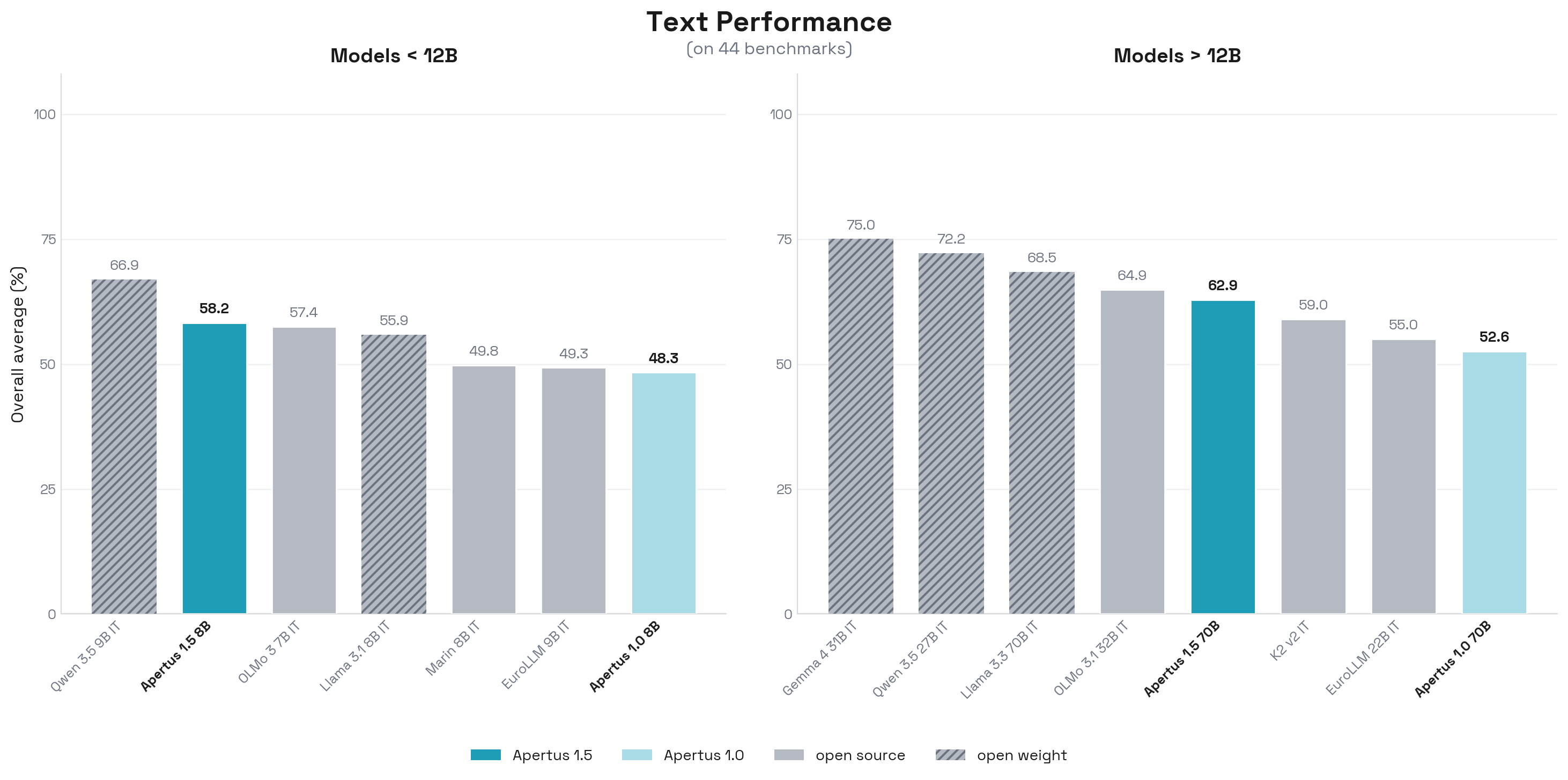
Text benchmarks cover various domains like knowledge (MMLU, MMLU-Pro, AGIEval, ARC-Challenge, TruthfulQA, CommonsenseQA, SQuAD v2, HellaSwag), instruction following (IFEval, Multi-IF, IFBench), chat (AlpacaEval), math (GSM8K, MATH, Minerva-MATH, MathQA, GSM8K-Platinum, MATH-500), coding (HumanEval, MBPP), reasoning (BIG-Bench Hard, GPQA, ACPBench, DROP), multilingual ability (Global-MMLU, MGSM, multilingual TruthfulQA, INCLUDE, mLogiQA, XNLI, multilingual ARC), cultural knowledge (BLEnD, CulturalBench, SwitzerlandQA), safety and bias (BBQ, ToxiGen, WMDP, MultiJail, PolygloToxicityPrompts), system-prompt robustness (RealGuardrails), and tool use (BFCL v3).
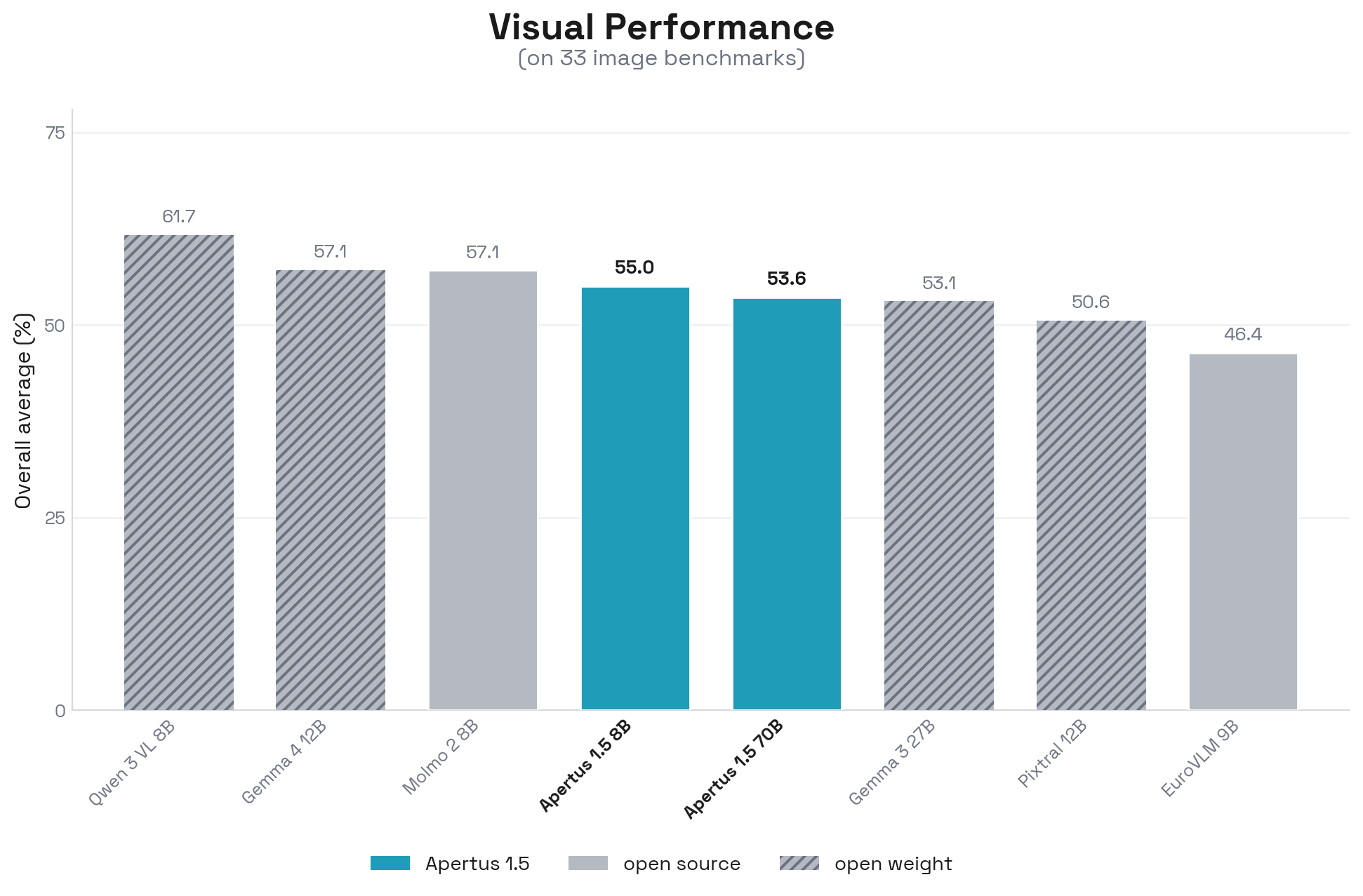
Image benchmarks cover general VQA and perception (GQA, MMStar, RealWorldQA, VQAv2, V\*Bench, CountBench), robustness and bias (MMVP, VLMs-Are-Biased, VLMsAreBlind), documents and OCR (ChartQA, DocVQA, SEED-Bench-2-Plus, InfoVQA, OmniDocBench), visual math and logic (BabyVision, MathVision, MathVista), STEM knowledge (AI2D, MMMU, MMMU-Pro, ScienceQA), spatial intelligence (MMSI, ViewSpatial, MindCube, EmbSpatial), remote sensing (FRIEDA, GeoBench, VRSBench-VQA), hallucination alignment (POPE), and medical imaging (PathVQA, PMC-VQA, SLAKE, VQA-RAD).
## Training
### Model
- **Architecture:** Transformer decoder
- **Pretraining tokens:** 17T for the 70B model, 19T for the 8B model
- **Precision:** bfloat16
## Limitations
Apertus can produce text on a variety of topics, but the generated content may not always be factually accurate, logically consistent, or free from biases present in the training data. These models should be used as assistive tools rather than definitive sources of information. Users should always verify important information and critically evaluate any generated content.
See the [Apertus Charter](https://apertus-ai.org/pages/charter/) for the alignment principles that govern the responses of the models.
## Legal Aspects
### EU AI Act Transparency Documentation and Code of Practice
Documentation and code of practice for the EU AI Act are available at the following links:
- [Apertus_1_5_EU_Public_Summary.pdf](https://github.com/swiss-ai/apertus-legal/blob/main/apertus_1.5/Apertus_1_5_EU_Public_Summary.pdf)
- [Apertus_1_5_EU_Code_of_Practice.pdf](https://github.com/swiss-ai/apertus-legal/blob/main/apertus_1.5/Apertus_1_5_EU_Code_of_Practice.pdf)
### Data Protection and Copyright Requests
For removal requests of personally identifiable information (PII) or of copyrighted content, please contact the respective dataset owners or us directly:
-
-
Currently no output filter is provided. We endeavour to address data protection deletion requests by updating filters in our data pipeline, and providing regular (at least bi-annual) releases to the model weights. We strongly advise downloading and updating new model weights from this site every six months.
## Citation
```bibtex
@techreport{apertus2026,
title = {Apertus 1.5: From Open Text Models to Open Multimodal Reasoners},
author = {{Project Apertus} and
Yixuan Xu and
Yassine Turki and
Vinko Sabolčec and
Valentina Pyatkin and
Tommy Chu and
Sven Najem-Meyer and
Sean F. Carroll and
Robert Smith and
Raphael Kreft and
Oscar Alessandro Tazza and
Oleg Lavrovsky and
Nicola Irmiger and
Matteo Santelmo and
Marian Schneider and
Juan García Giraldo and
Hanna Yukhymenko and
Eduard Ďurech and
Davit Melikidze and
Dani Tamayo and
Bettina Messmer and
Aryan Ahadinia and
Anunay Yadav and
Allen Huang and
Ahmad Fraij and
Alessandro Bombarda and
Alex Padula and
Alexander Hägele and
Alexander Sternfeld and
Anna Hedström and
Anna Kosovskaia and
Arthur Wuhrmann and
Arundhati Balasubramaniam and
Badr Al Mahouri and
Barna Pasztor and
Bartosz Szostakiewicz and
Bich Ngoc Doan and
Bryan Schmid and
Burak Sezen and
Camille Challier and
Clément Charmillot and
Dana Shayakhmetova and
Daniel Perruchoud and
David Brüggemann and
David Isztl and
Elia Palme and
Emma Anastassova and
Fabian Bösch and
Faruk Zahiragić and
Fawzi Roberto Mohamed and
Fiona Panicali and
Florian Kolly and
Flynn Guerra and
Francesco Monti and
Frederike Lübeck and
Gennaro Oliva and
Haofeng Yang and
Haoliang Shang and
Helen El Khoury and
Henrique Mendonça and
Jannis Vamvas and
Jérome Landolt and
Jessica Lam and
Jingchun Xiao and
Jonathan Coles and
Joshua Oyebanji and
Khanh Nguyen and
Konstantinos Pitas and
Lasse B. Strand and
Li Mi and
Loïc Deslarzes and
Lorenzo Baggi and
Lorenzo Noci and
Luca Baumann and
Luca Sartori and
Lukas Drescher and
Marco De Negri and
Marco Passerini and
Mark Klein and
Marko Stojanovic and
Martin Majsec and
Matin Ansaripour and
Mattea Busato and
Mauro Pellonara and
Max Neuwinger and
Michael Graber and
Michal Tešnar and
Michelle Wastl and
Miguel Gila and
Mikolaj Boronski and
Morgane Magnin and
Moritz Reihs and
Mukhammadali Sayfiddinov and
Nathan Ranchin and
Nicolas Cuveillier and
Oscar Wohlfahrt and
Qianqian Zou and
Rada Kamysheva and
Rita Sevastjanova and
Roman Machacek and
Sebastian Keller and
Simon Matrenok and
Simon Pierre and
Stefano Schuppli and
Suei-Wen Chen and
Szabina Horváth-Mikulas and
Taliesin Perez and
Thilo Spinner and
Thomas Kleine Buening and
Tim Robinson and
Tymoteusz Kwiecinski and
Vilém Zouhar and
Vinzenz Thoma and
Xiaozhe Yao and
Yannick Metz and
Yuhei Fukuhara and
Yusif Askari and
Zixuan Chen and
Alexander Ilic and
Ana Klimovic and
Andreas Krause and
Andrei Kucharavy and
Elliott Ash and
Joost VandeVondele and
Martin Rajman and
Mennatallah El-Assady and
Thomas Schulthess and
Timo Kehrer and
Torsten Hoefler and
Antoine Bosselut and
Martin Jaggi and
Imanol Schlag},
institution = {Swiss AI Initiative},
type = {Technical Report},
year = {2026},
eprint = {2610.15542},
archivePrefix = {arXiv},
primaryClass = {cs.CL},
url = {https://arxiv.org/abs/2610.15542},
}
```
## Contact
To contact us, please use the links at or send an email to .