---
title: CNPM
canonical_url: "https://www.modelscope.cn/datasets/ccmusic-database/CNPM"
md_url: "https://www.modelscope.cn/datasets/ccmusic-database/CNPM.md"
repository: ccmusic-database/CNPM
chinese_name: "中国民族五声调式数据集 Chinese National Pentatonic Mode Dataset"
last_updated: 2026-08-05
license: CC-BY-NC-ND
storage_size: "3.0 GB"
domain:
- audio
tasks:
- audio-classification
downloads: 13594
stars: 19
---
# CNPM
> CNPM - ccmusic-database 在 ModelScope 开源的数据集。本数据集基于世界音乐数据集建设中手工标注与计算机相结合的工作思路,收集并标注“宫、商、角、徵、羽”五种调式(含五声、六声、七声)的音频,同时对中国民族五声调式的判断做出详细解析,并找到应用场景与技术模型,可以为中国民族音乐特征的分析与检索提供原始数据。
ccmusic-database/CNPM 是 ModelScope 魔搭社区上的audio-classification数据集,涉及 audio 领域,存储大小 3.0 GB,采用 CC-BY-NC-ND 许可。
- **Repository**: ccmusic-database/CNPM
- **License**: CC-BY-NC-ND
- **Tasks**: audio-classification
- **Domain**: audio
- **Storage size**: 3.0 GB
- **Downloads**: 13594
- **Stars**: 19
- **Last updated**: 2026-08-05
Source: https://www.modelscope.cn/datasets/ccmusic-database/CNPM
---
# Intro 简介
## Original Content 原始内容
The dataset is initially created by [[1]](https://archives.ismir.net/ismir2022/paper/000041.pdf). It is then expanded and used for automatic Chinese national pentatonic mode recognition by [[2]](https://kns.cnki.net/kcms2/article/abstract?v=lD5CuVSaeOtw0E2oWliKSMrLiLDt9iwvkwoTgSclPspwUECyt4uNZ6T7DCLlfwMqohXCQXkFzf_XjAUOQ3CAkhPqNj20H8eG9UfUVuHEey0x7Kqp32fMlJiM9xuPtdVMvC1PB2qW0qI=&uniplatform=NZKPT&src=copy), to which readers can refer for more details along with a brief introduction to the modern theory of Chinese pentatonic mode. This includes the definition of "system", "tonic", "pattern", and "type," which will be included in one unified table during our integration process as described below. The original dataset includes audio recordings and annotations of five modes of Chinese music, encompassing the _Gong (宫), Shang (商), Jue (角), Zhi (徵), and Yu (羽)_ modes. The total recording number is 287.
原始数据集来源于 [中国民族五声调式数据集](https://ccmusic-database.github.io/database/csmtd.html#shou10), 基于世界音乐数据库建设中手工标注与计算机相结合的工作思路, 收集并标注了“宫、商、角、徵、羽”五种调式(含五声、六声、七声)的音频。同时对中国民族五声调式的判断做出详细解析, 并找到应用场景与技术模型, 可以为中国民族音乐特征的分析与检索提供原始数据。
## Integration 集成
Similar to the Guzheng Tech99 dataset in Section 1, the labels in this dataset were initially stored in a separate CSV file, which led to certain usability issues. Through our integration, labels are integrated with audio data into a single dictionary. After the integration, the data structure consists of seven columns: the first and second columns denote the audio recording (sampled at 44,100 Hz) and mel spectrogram. The subsequent columns represent the system, tonic, pattern, and type of the musical piece, respectively. The final column contains an additional Chinese name of the mode. The total recording number remains at 287, and the total duration is 858.63 minutes. The average duration is 179.51 seconds.
We have constructed the [default subset](#usage-快速使用) of this integrated version of the dataset, and its data structure can be viewed in the [viewer](https://www.modelscope.cn/datasets/ccmusic-database/CNPM/dataPeview). As this dataset has been cited and used in published articles, no further eval subset needs to be constructed for evaluation. Because the default subset is multi-labelled, it is difficult to maintain the integrity of labels in the split for all label columns, hence only a single split for the training set is provided. Users can perform their own splits on specified columns according to their specific downstream tasks. Building on the default subset, we segmented the audio into 20-second slices and used zero padding to complete segments shorter than 20 seconds. The audio was then converted into mel, CQT, and chroma spectrograms. This process resulted in the construction of the [eval subset](#usage-快速使用) for dataset evaluation experiments.
基于上述原始数据, 经过数据处理后我们构建了本集成版数据集的 [默认子集](#usage-快速使用), 其数据结构可在 [数据预览](https://www.modelscope.cn/datasets/ccmusic-database/CNPM/dataPeview) 查看。由于本数据集已被发表的文章的引用和使用, 无需进一步构建评估子集。由于默认子集是多标签的, 很难在所有标签列的分割中同时保持标签的完整性, 因此只提供了训练集单个分割。用户可以根据自己的具体下游任务需求, 自行针对指定的列进行分割。在默认子集的基础上,我们将音频以 20 秒为切片进行切割,并对不足 20 秒的片段采用零填充的方式补全,随后分别将其转换为 mel、CQT 和 chroma 频谱,从而构造出 [评估子集](#usage-快速使用),用于数据集的评估实验。
## Statistics 统计
In this part, we provide statistics for the "pattern" in the dataset, which includes five categories: Gong, Shang, Jue, Zhi, and Yu. Our evaluation is also conducted on "pattern." In a Western context, identifying these patterns is analogous to identifying a musical mode, such as determining whether a piece of music is in the Dorian mode or Lydian mode. These patterns form the core of modern Chinese pentatonic mode theory.
|  |  |  |
| :--------------------------------------------------------------------------------------------: | :----------------------------------------------------------------------------------------: | :--------------------------------------------------------------------------------------------: |
| **Fig. 1** | **Fig. 2** | **Fig. 3** |
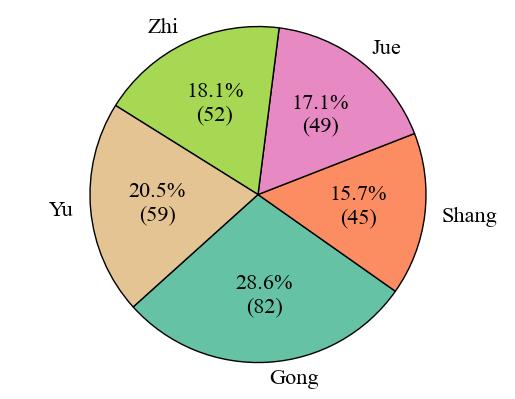
To begin with, **Fig. 1** presents the number of audio clips by category. Gong accounts for the largest proportion among all modes, making up 28.6% of the dataset with 82 audio clips. The second-largest mode is Yu, accounting for 20.6% with 59 audio clips. The smallest mode is Shang, which accounts for 15.7% with only 45 audio clips. The difference in proportion between the largest and smallest modes is 12.9%.
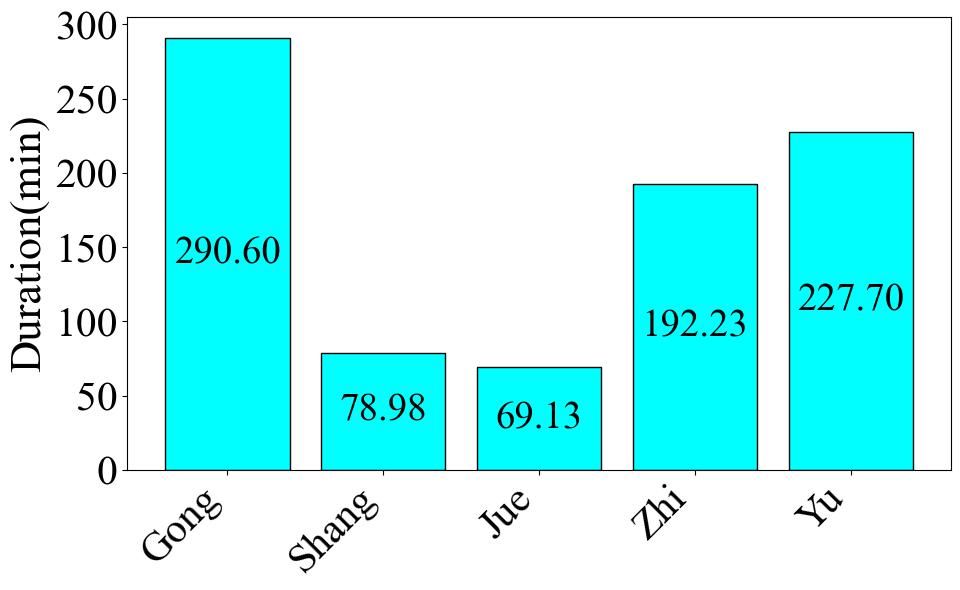
Moving on to **Fig. 2**, it displays the total audio duration by category. The total duration of Gong audio is significantly longer than that of other modes, at 290.6 minutes. The second-longest mode is Yu, with a total duration of 227.7 minutes, consistent with the proportions shown in the pie chart. However, the shortest mode is not Shang, which has the smallest proportion in the pie chart, but rather Jue, with a total duration of only 69.13 minutes. The difference in duration between the longest and shortest modes is 221.47 minutes.
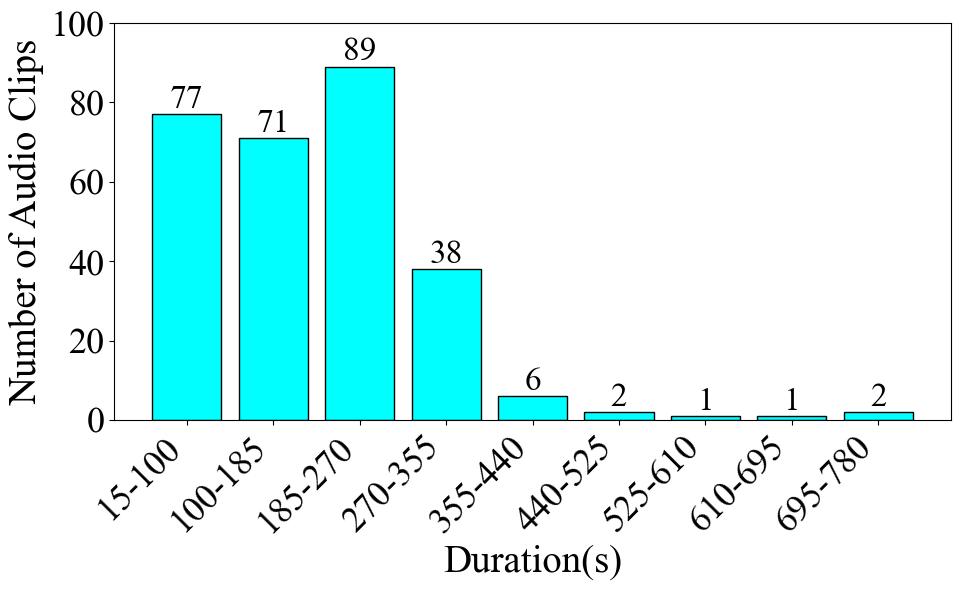
When we consider the pie chart and the duration statistics together, they clearly expose a data imbalance problem within the dataset. Finally, **Fig. 3** depicts the number of audio clips across various duration intervals. The time interval with the highest concentration of audio clips is 185-270 seconds, closely followed by 15-100 seconds. However, once we go beyond 355 seconds, the number of audio clips experiences a sharp decline, with only single-digit counts in these longer intervals.
| Statistical items 统计项 | Values 值 |
| :---------------------------------------------------------: | :------------------: |
| Total count 总数据量 | `287` |
| Total duration(s) 总时长(秒) | `51517.97027494331` |
| Mean duration(s) 平均时长(秒) | `179.50512290921017` |
| Min duration(s) 最短时长(秒) | `15.413333333333334` |
| Max duration(s) 最长时长(秒) | `778.0065306122449` |
| Classes in the longest audio duartion interval 最长时长类别 | `Jue, Zhi` |
| Eval subset total 评估子集总量 | `2724` |
## Labels 标签
In comparison to the separation of the label CSV file and audio data in the raw dataset, we removed metadata columns irrelevant to the experiments during the data preprocessing stage, retaining only the columns system, tonic, pattern, type, and mode name. Additionally, we extracted the mel spectrograms from the original audio and integrated the original audio, mel spectrograms, and the aforementioned five columns into a single data table with viewer.
相比于原始数据中标签文件与音频数据分离的情况, 在数据整理阶段, 我们去除了标签文件中与实验无关的元数据列, 仅保留了*同宫系统*、*主音音名*、*样式*、*种类*和*调式全称*五列。此外, 我们从原始音频中提取了 mel 频谱, 并将原始音频、mel 频谱以及上述五列标签整合到同一可预览的数据表中。
The information of the tracks and their corresponding mode labels with the following rules:
曲目的信息和其对应的调式标签, 规则如下:
### System 同宫系统
| TongGong System/同宫系统 | Label |
| :----------------------: | :---: |
| C | 0 |
| #C/bD | 1 |
| D | 2 |
| #D/bE | 3 |
| E | 4 |
| F | 5 |
| #F/bG | 6 |
| G | 7 |
| #G/bA | 8 |
| A | 9 |
| #A/bB | 10 |
| B | 11 |
### Mode 调式
Pitch of Tonic/主音音高:(The rules are the same as the TongGong system/规则与同宫系统相同)
#### Pattern 样式
| Mode Pattern/调式样式 | Label |
| :-------------------: | :---: |
| Gong/宫 | 0 |
| Shang/商 | 1 |
| Jue/角 | 2 |
| Zhi/徵 | 3 |
| Yu/羽 | 4 |
#### Type 种类
| Mode Type/调式种类 | Label |
| :-------------------------------: | :---: |
| Pentatonic/五声 | 0 |
| Hexatonic (Qingjue)/六声(清角) | 1 |
| Hexatonic (Biangong)/六声(变宫) | 2 |
| Heptatonic Yayue/七声雅乐 | 3 |
| Heptatonic Qingyue/七声清乐 | 4 |
| Heptatonic Yanyue/七声燕乐 | 5 |
## Usage 快速使用
:modelscope-code[]{type="sdk"}
## Clone with HTTP 下载
```bash
GIT_LFS_SKIP_SMUDGE=1
```
:modelscope-code[]{type="git"}
## Mirror 镜像
## Evaluation 评估
[1] [Wang, Z., Che, M., Yang, Y., Meng, W., Li, Q., Xia, F., and Li, W. (2022b). Automatic chinese national pentatonic modes recognition using convolutional neural network. In Proc. Int. Society Music Information Retrieval (ISMIR).](https://archives.ismir.net/ismir2022/paper/000041.pdf)
[2] [Ren, W., Che, M., Wang, Z., Meng, W., Li, Q., Hu, J., Xia, F., and Li, W. (2022). Cnpm database: A chinese national pentatonic modulation database for computational musicology. Journal of Fudan University(Natural Science), 61(5):9.](https://kns.cnki.net/kcms2/article/abstract?v=lD5CuVSaeOtw0E2oWliKSMrLiLDt9iwvkwoTgSclPspwUECyt4uNZ6T7DCLlfwMqohXCQXkFzf_XjAUOQ3CAkhPqNj20H8eG9UfUVuHEey0x7Kqp32fMlJiM9xuPtdVMvC1PB2qW0qI=&uniplatform=NZKPT&src=copy)
[3]
## Cite 引用
```bibtex
@inproceedings{WangCYMLX022,
author = {Zhaowen Wang and Mingjin Che and Yue Yang and Wenwu Meng and Qinyu Li and Fan Xia and Wei Li},
title = {Automatic Chinese National Pentatonic Modes Recognition Using Convolutional Neural Network},
booktitle = {Proceedings of the 23rd International Society for Music Information Retrieval Conference, {ISMIR} 2022, Bengaluru, India, December 4-8, 2022},
pages = {345-352},
year = {2022}
}
```